
Background
The Würth Group is world market leader in its core business: assembly and fastening equipment. Würth was an early licensee of the WoodWelding (WW) technology, with the aim of developing a handheld tool for use in the construction trade. They approached us to work find ways on how to make this possible.
Challenge
Würth's interest in this project was driven by evolutions in the furniture field, particularly the disruptive use of lightweight honeycomb panels, which are difficult to fix using traditional methods.
The challenge was to transform the connection technique into a compact and portable tool for daily use. Furthermore, the handtool should cost no more than a thousand francs, similar to power tools for carpentry.
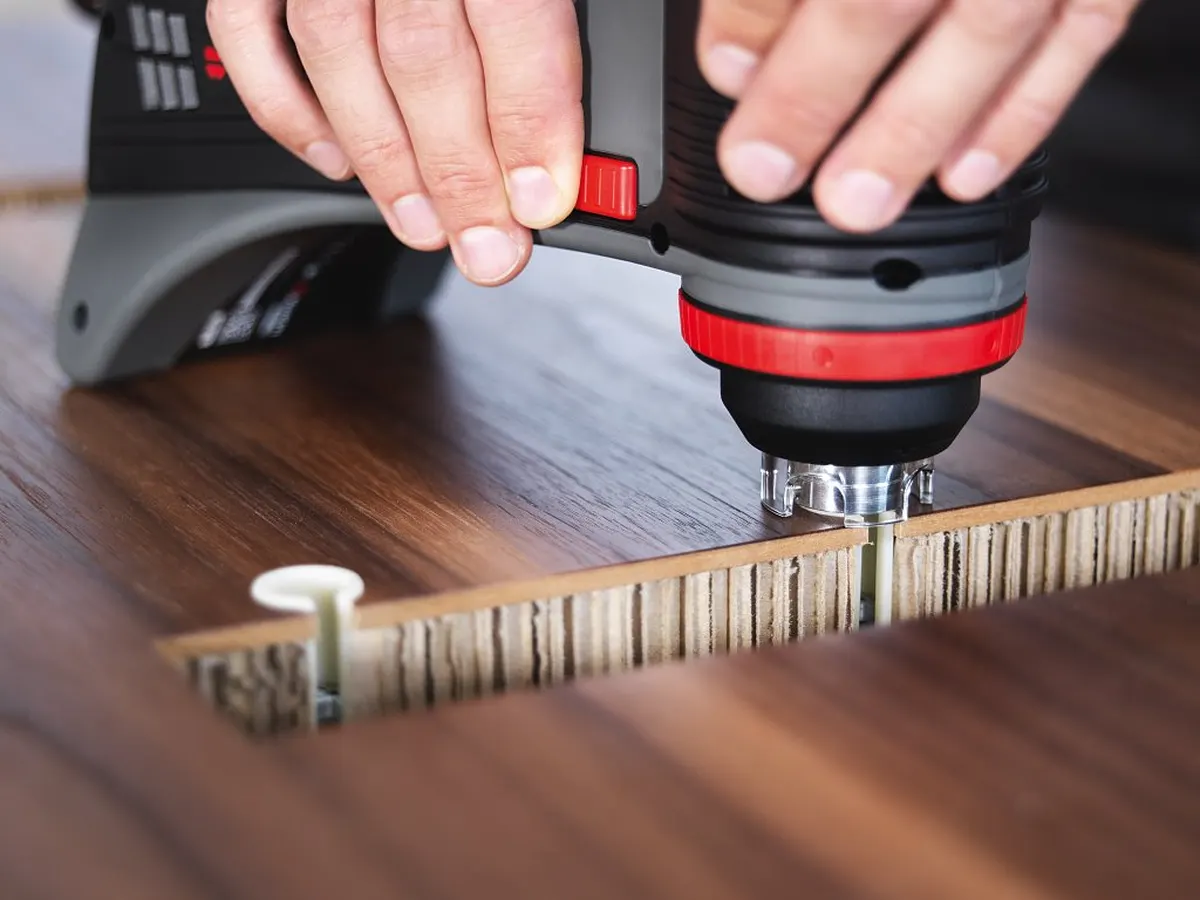
Lastly, the tool should be designed to be adaptable to different applications, but the intended primary use was to simply and efficiently fix thermoplastic dowels into hollow core panels.
Solution
Reviewing the first concepts with mock-ups, we discovered a fundamental handling criteria: the need to provide precise and even pressure on the thermoplastic dowel. This was difficult to achieve with a completely unsupported tool design (e.g. like a power drill).
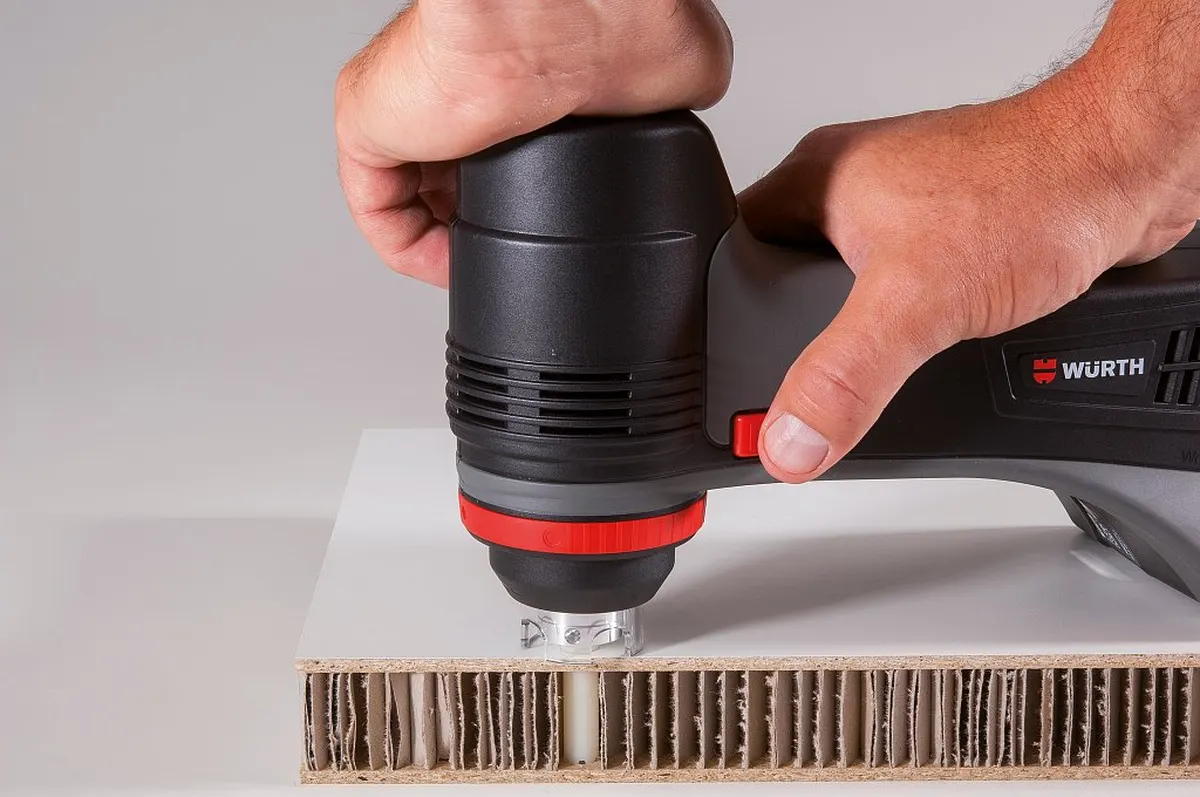
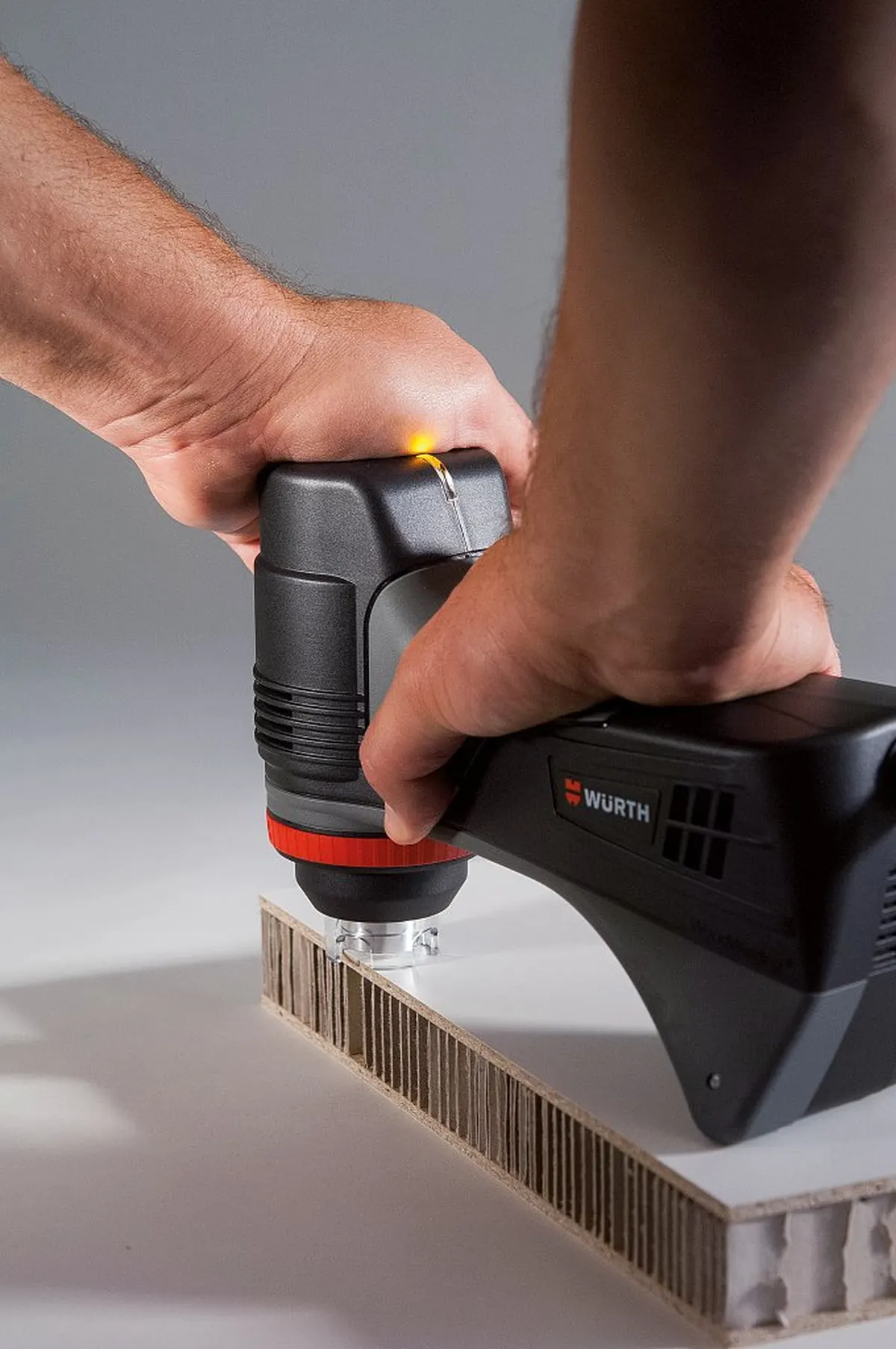
Therefore, in a workshop together with EMD and Würth, the concept developed from a parallel translation to a pivoting movement based on three points (tripod) to give the tool a stable position for a precise application of dowels. The front point, where the sonotrode is located, is supported by a wider rear pivot foot at the base of the machine handle.
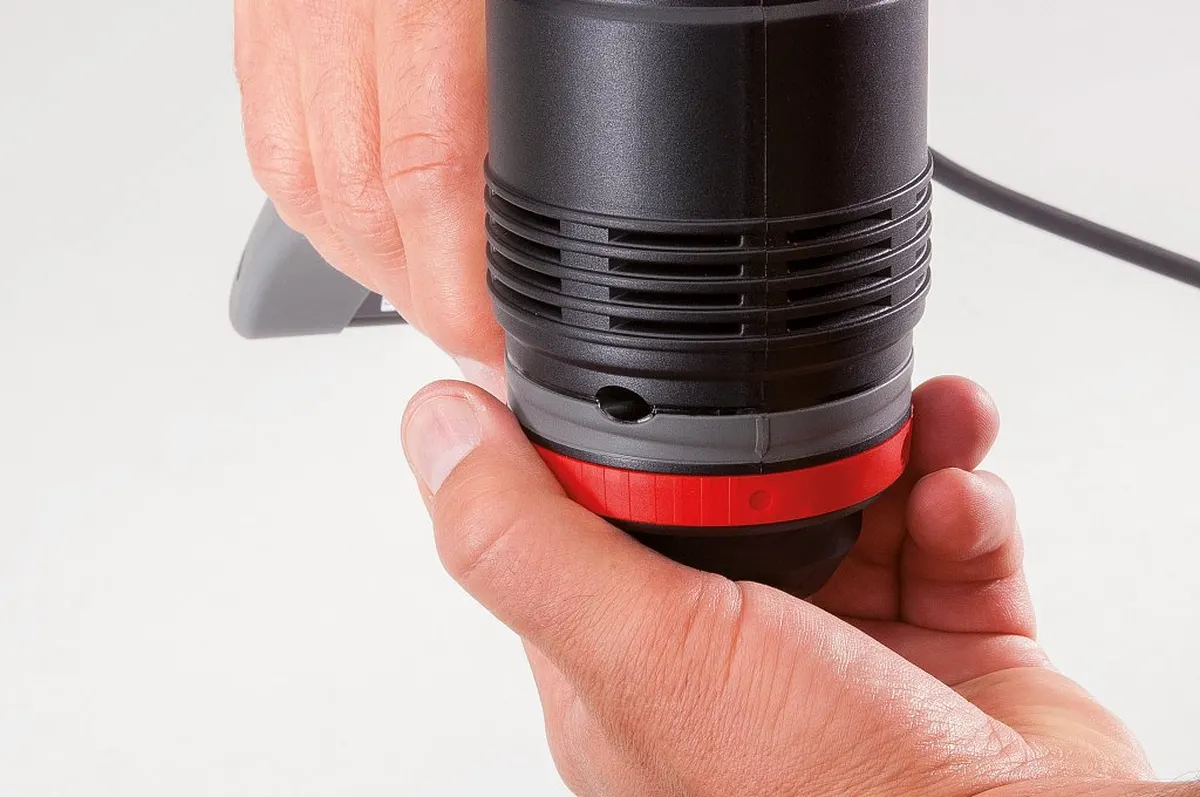
Because of this design, the machine can always be used parallel to the work surface. The rear foot is made of softer material, so the veneers of the honeycomb plates are not scratched by the pressure. Finally, it was important to make the case Würth-compliant. Designed in black with red controls, the device was realized according to guidelines of the client’s corporate identity, integrating the air vent and the profile of the buttons.
Results
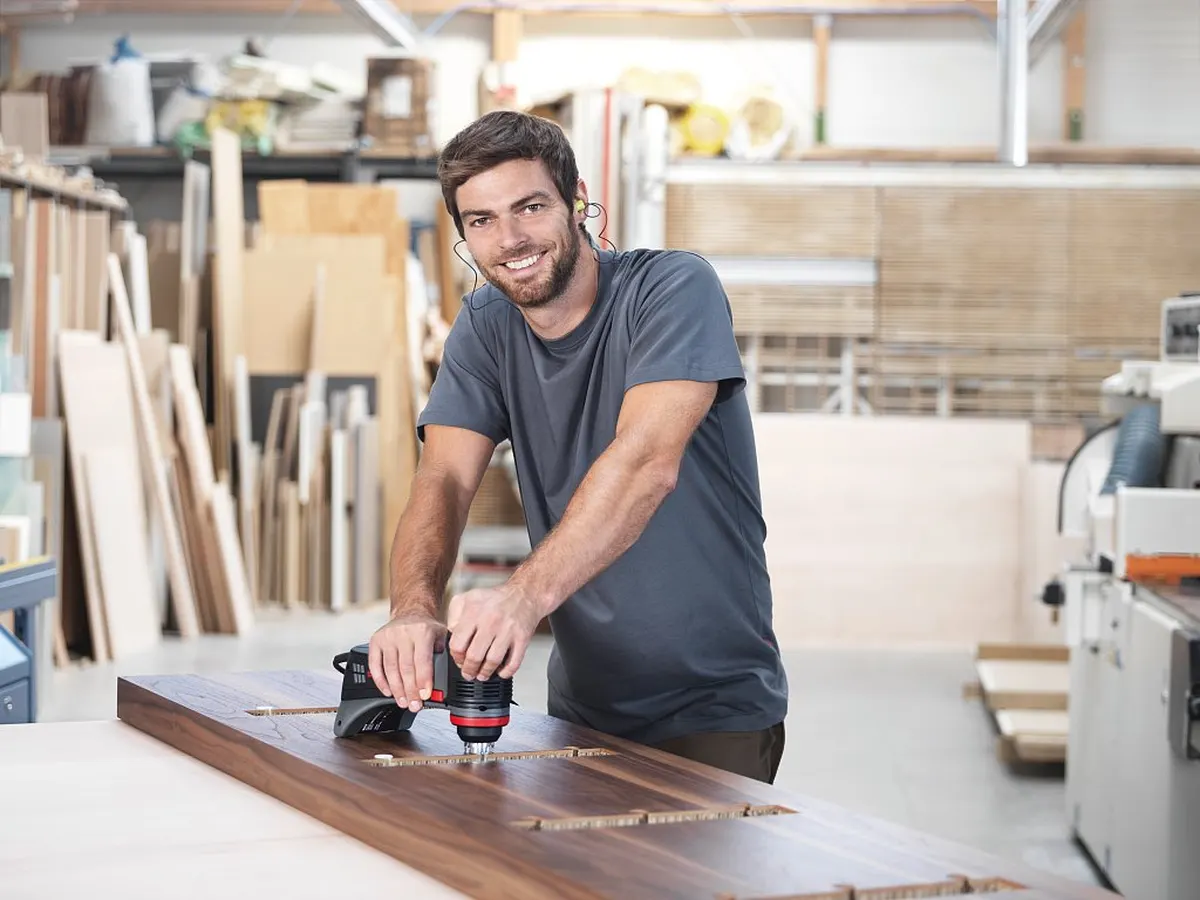
The finished device is now slightly larger than a drill and weighs less than 2 kg. It is operated with 2 hands: one pushes forward on the flattened head, the other triggers a button to start the ultrasonic vibration. If this is activated, the yellow light on top of the machine lights up. The target selling price was reached. The first intended was in shop and exhibition construction, and in interior design for the caravan sector.
The WoodWelding connection technique is also proving to be useful for cabinet makers and carpenters. Würth and carpentry company Röthlisberger presented three studies from Moritz Schmid, Atelier Oї and Studio Hannes Wettstein.

Do you have a similar challenge?
Are you inspired by this case study and interested in discussing a similar collaboration?If so, then reach out to one of our experts!